
At Multitrade, we go the extra mile to provide our clients with complete usage information and safety tips so they can have the best experience possible with our products. If you have lost the safety instructions for climbing your ladder or wish to revise them, please refer to the following guidelines.
General Information
- Read all the manufacturer’s instructions.
- Be aware of the maximum load and maximum users that your ladder is designed to accommodate.
- Check the ladder before use, starting with the feet of the ladder.
- Place the ladder at the correct angle to prevent it from sliding down or falling backwards.
- The ladder must extend at least 1 meter over the point you are climbing onto.
- Secure both the upper and lower ends of the ladder.
- Ensure a two-element ladder is fully open.
- Make sure both sides are latched securely.
- Place the ladder on stable ground.
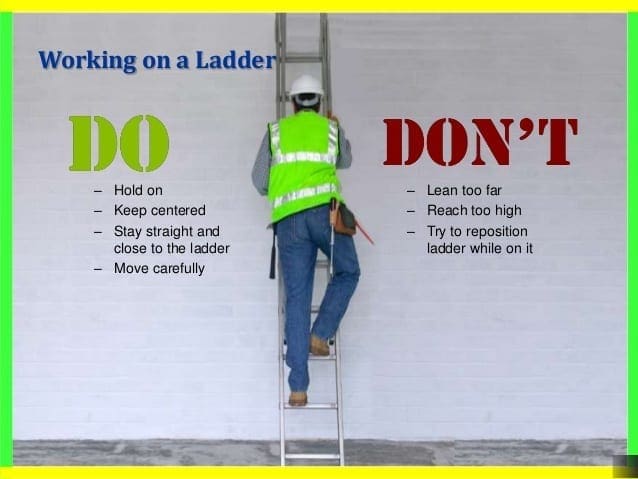
- Always climb up or down facing the ladder.
- Each side can only carry one person.
- Side stepping is dangerous.
- The floor must be clean.
- Do not stand on the last three upper steps of leaning and extension ladders.
- Do not stand on the upper two steps of a double-sided ladder without a handrail at the top end.
- Do not stand on the upper four steps of a three-element ladder, and do not exceed the top of the ‘A’ ladder at the base.
- Do not lean over to either side.
- Do not carry large or heavy objects while on the ladder.
- Do not use a standing ladder as a leaning ladder unless specifically designed for this purpose.
- Maximum load is not indicated for any other use except as a ladder.
- Ensure that the upper part of the ladder is adequately positioned.
- Be aware of power lines when carrying or climbing a ladder.
- Do not use the ladder as a bridge or scaffold.
- Be cautious of low-cost ladders that lack adequate certification.
Information for the User
Before use:
- Certain health conditions, such as the use of drugs and medications, may endanger your health and safety. Ensure you are healthy and sober before using the ladder.
- When transporting a ladder on a roof girder or vehicle, securely place and fasten the ladder to prevent damage.
- After delivery and before the first use, check the ladder’s condition and proper functioning.
- Always ensure the ladder is not damaged and is safe to use before use.
- Professional users must perform periodic checks of their ladders.
- Ensure the ladder is suitable for the specific job and never use a damaged ladder.
- Remove all dirt from the ladder before use, including wet paint, oil, mud, grease, etc.
- Before using a ladder at work, conduct a risk assessment according to the legal regulations in your country.
Placing the Ladder and Finding Its Position
- The ladder must be placed in its proper position. Leaning ladders should be at an inclination of 1:4, with rungs or steps placed horizontally; a two-legged ladder must be fully open.
- If locking devices are present on the ladder, they must be fully fastened before use.
- The ladder must stand on flat and immovable ground.
- A leaning ladder must be leaned against a straight, solid surface and secured correctly before use, e.g., by fastening it or using other proper devices to ensure stability.
- Do not move the ladder from the top.
- When placing the ladder, ensure you do not hit any person or obstacle. If possible, close any doors (excluding emergency exits) and windows in the working area.
- Gather all information concerning risks present in the working area due to electrical equipment, such as high-voltage power lines or other electrical hazards.
- The ladder must be placed on its feet, not on rungs or steps.
- Do not place the ladder on wet floors (ice, shine, very dirty, slippery) unless you take additional measures to prevent sliding.
The Use of the Ladder
- Be careful not to exceed the maximum load of the ladder.
- Do not lean over the ladder too much on either side; your belt buckle must always be between the two sides of the ladder, with the user standing on the same level on each step or rung.
- At greater heights, do not step out of the ladder without additional safety measures, such as fastening or applying proper devices for stability.
- Do not use a two-legged ladder to climb to other levels.
- Do not stand on the upper three steps or rungs of a leaning ladder.
- Without a platform or tool shelf and safety rail for hands and knees, do not stand on the upper two steps or rungs of a two-legged ladder.
- Do not stand on the upper four steps or rungs of a two-legged ladder with an extension ladder placed.
- Use the ladder only for non-demanding and short-duration activities.
- For unavoidable work under high voltage, use insulating ladders.
- In bad weather conditions, such as strong winds, do not use the ladder outside in open spaces.
- Keep children from playing on the ladder.
- If possible, close doors (excluding emergency exits) and windows in the working area.
- Climb up or down the ladder facing the ladder.
- Hold the ladder securely when climbing up or down.
- Do not use the ladder as a bridge.
- Wear appropriate shoes when climbing the ladder.
- Prevent any side overload of the ladder, e.g., when drilling into walls and concrete.
- Take regular breaks when standing on the ladder for extended periods, as fatigue can increase danger.
- Leaning ladders that enable access to higher spots must extend at least one meter over the leaning point.
- Carry only light objects that are easy to transfer from one hand to another when standing or climbing up and down the ladder.
- Avoid work that could cause side overload of the two-legged ladders, such as side drilling through solid materials, walls, or concrete.
- When working with one hand, hold onto the ladder securely. If this is not possible, use additional safety measures.
Repair, Maintenance, and Storage
- Repairs and maintenance can only be carried out by professional staff in accordance with the regulations and instructions of the manufacturer.
- The ladder must be stored according to the manufacturer’s instructions.
- According to Article 4 of the EN 131-3, the owner of the ladder must inform the user about these instructions.