
Selecting the right Tellure Rota Wheels
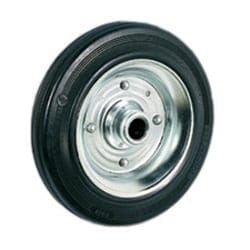
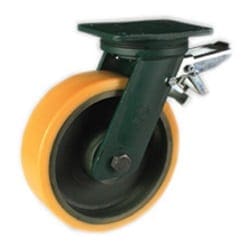
SERIES 22
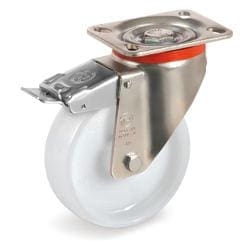
SERIES 32
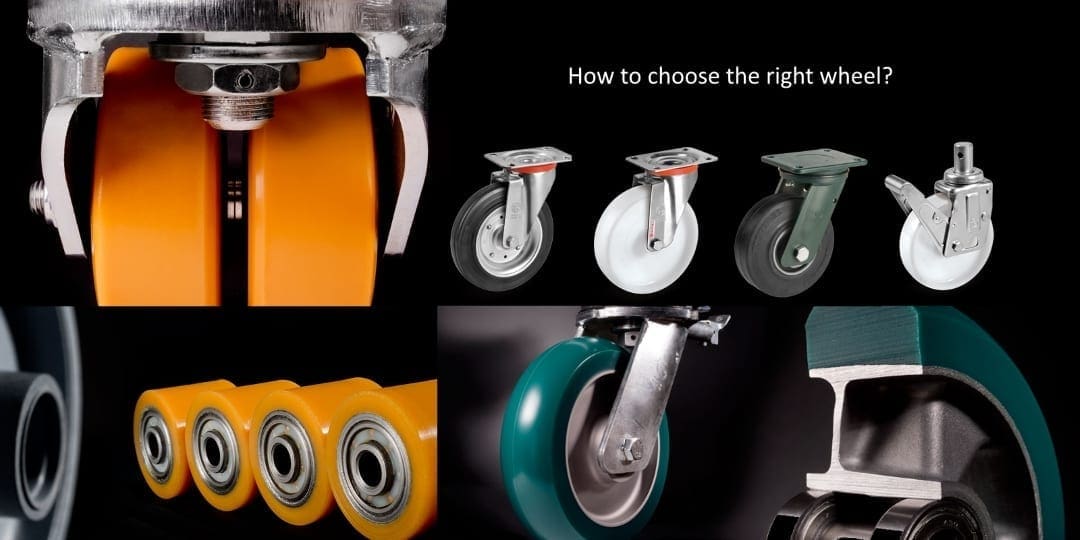
Selecting the right Tellure Rota Wheel
The safety and ease of handling of a trolley depend on the choice of the most suitable wheel. The selection must be made according to the following procedure:
- Calculate the minimum carrying capacity required to ensure safe handling. This is determined by the weight of the load, its nature (solid or liquid), and the tare of the trolley.
- Select the recommended wheel series for the type of floor (nature and condition of the floor) and then choose only the recommended categories for the environment of use (temperature, humidity, aggressive chemical substances).
- Determine the wheel dimensions (diameter and tyre width) having the minimum required carrying capacity to guarantee ease of movement depending on the type of use: static use, manual propulsion, towed mechanical propulsion, self-powered propulsion.
- Combine the wheel with the most suitable castor for the application environment, the required carrying capacity, and speed.
Nature and condition of the floor
The type of floor and the presence of any obstacles will influence the thrust/traction force required to move the trolley, the transmission of vibrations, and the wear of the wheel:
- For uneven floors or floors with obstacles, the wheels should have a soft, thick tread and be of large diameter.
- For smooth floors and heavy loads, the normal practice is to select wheels with a more rigid tread.
| Tiled floor | Plastic materials, polyurethane, rubber |
| Asphalt floor | Rubber or elastic polyurethane |
| Cement-resin floor | Plastic materials, polyurethane, rubber |
| Unsurfaced floors | Rubber or elastic polyurethane |
| Floor contaminated with machining chips | Rubber or elastic polyurethane |
| Floor with grating | Rubber or elastic polyurethane |
Environment of use
The materials of which the wheel and castor are made may be more or less suitable for use in aggressive environments: extreme temperatures, high humidity, acids, solvents, alkalis, and hydrocarbons.
Tellure Rota provides:
- A table showing compatibility of the wheel materials with a detailed list of chemical substances.
- A table showing derating of carrying capacity in accordance with different temperatures.
Weight and nature of the load
The load weight, load type (liquid or solid), and trolley tare determine the minimum carrying capacity required of the wheel to ensure safe handling.
| Solid Load: MINIMUM CARRYING CAPACITY REQUIRED = (SOLID LOAD WEIGHT + TROLLEY TARE): 3 (3 out of 4 wheels are considered to be constantly in contact with the ground). |
| Liquid Load: MINIMUM CARRYING CAPACITY REQUIRED = (LIQUID LOAD WEIGHT + TROLLEY TARE): 2 (2 out of 4 wheels are considered to be alternately in contact with the ground). |
Means of traction and speed
Static use
For static use (trolley moved only occasionally and stationary most of the time), it is sufficient to check:
STATIC CARRYING CAPACITY OF THE WHEEL > MINIMUM CARRYING CAPACITY REQUIRED
(3 out of 4 wheels are considered to be constantly in contact with the ground).
Conversely, if the trolley is to be used frequently or over long distances, the type of handling must be assessed: manual, towed with mechanical means, or self-powered.
Manual handling
The trolley speed is generally less than 4 km/h; check that:
DYNAMIC CARRYING CAPACITY OF THE WHEEL > MINIMUM CARRYING CAPACITY REQUIRED
ROLLING RESISTANCE > (SOLID/LIQUID LOAD WEIGHT + TROLLEY TARE): 4
Tellure Rota shows the rolling resistance value for each wheel, which is the maximum applicable load at which the traction/thrust effort remains below 5 daN. The lower the rolling resistance of a wheel, the less effort is required.
Towed mechanical propulsion
The dynamic carrying capacity of the wheels refers to a speed no higher than 4 km/h (1.1 m/s); if the speed exceeds this value, the carrying capacity value decreases. Use the carrying capacity correction factor shown in the speed and capacity variations table and check:
WHEEL DYNAMIC CARRYING CAPACITY X CORRECTION FACTOR (%) > MINIMUM REQUIRED CARRYING CAPACITY
Not all types of wheels can be used with mechanical propulsion; choose only the series shown in the table, combined with adequate castors.
Self-powered mechanical propulsion
In this case, the wheels are subjected to particular types of stress that differ from case to case. Contact Tellure Rota to choose the most suitable product for your application.
Contact us for more help
If you require further assistance, please visit our store or contact us by calling (00356) 21460195 or (00356) 21465006. You can also email us at admin@multitrademalta.com.
We can help you with the correct elements for your next DIY project, ensuring that you get exactly what you need without breaking the bank. We pride ourselves on our high level of customer care.